Bump And Run Reversal Complete Guide
What is Bump And Run Reversal?
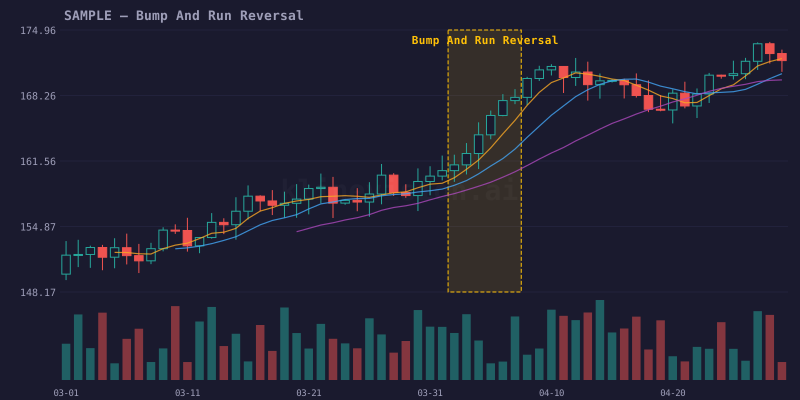
The Bump and Run Reversal (BARR) Top is a powerful bearish reversal pattern identified and popularized by Thomas Bulkowski. It characterizes a price move that accelerates too quickly, creating a speculative bubble that eventually collapses. The pattern is divided into three distinct phases: the lead-in, the bump, and the run. During the lead-in phase, the price follows a steady uptrend with a trendline angle typically between 30 and 45 degrees. This phase establishes the baseline for the trend and should ideally last at least a month. The bump phase begins when the price trajectory steepens significantly, often reaching an angle of 45 to 60 degrees or more. This represents a period of excessive speculation. A critical technical requirement for a valid BARR is that the vertical distance from the highest peak in the bump phase to the lead-in trendline must be at least twice the vertical distance from the highest peak in the lead-in phase to that same trendline. Volume typically surges during the initial acceleration of the bump but tends to diminish as the price reaches its ultimate peak, signaling exhaustion. The 'run' phase is triggered when the price falls back and closes below the lead-in trendline. According to Bulkowski’s 'Encyclopedia of Chart Patterns,' the BARR Top is exceptionally reliable, with a failure rate of only 19% in bull markets. The average decline following a confirmed breakout is approximately 19%. Traders often set their ultimate price target at the level where the lead-in phase first began. The pattern is most effective on daily or weekly charts where the trendline has been tested multiple times, providing a clear exit for longs and an entry for short sellers.
Identification Rules
- The lead-in trendline must have an angle between 30 and 45 degrees.
- The bump phase angle must be significantly steeper, usually between 45 and 60 degrees.
- The maximum height of the bump must be at least twice the maximum height of the lead-in phase relative to the trendline.
- A valid reversal is confirmed only when the price closes below the lead-in trendline.
References
- Thomas N. Bulkowski (2005). Encyclopedia of Chart Patterns.
- Steve Nison (2001). Japanese Candlestick Charting Techniques.
FAQ
What is the success rate of the Bump and Run Reversal Top?
According to Bulkowski's research, the pattern has a low failure rate of about 19% in bull markets, meaning it reaches its target roughly 81% of the time.
How do you calculate the price target for this pattern?
The technical price target is the price level at the start of the lead-in phase trendline.
Does volume play a role in confirming the BARR Top?
Yes, volume should be high during the lead-in and the start of the bump, but it often decreases near the peak of the bump.
What is the minimum duration for the lead-in phase?
The lead-in phase should ideally last at least 30 days to establish a valid trendline.
Can this pattern be used on intraday charts?
While it can appear, it is most reliable on daily and weekly timeframes where speculative bubbles are more clearly defined.
More Analysis
Parts of this page (FAQ, introductions) are AI-assisted. Core data and statistics are algorithmically computed. All pattern definitions are human-reviewed.
Disclaimer: This page is based on publicly available market data and algorithmically generated technical analysis. It does not constitute investment advice. Historical pattern statistics do not guarantee future performance. Invest at your own risk.
Data source: EODHD · © 2026 KlineVision AI