Double Top Complete Guide
What is Double Top?
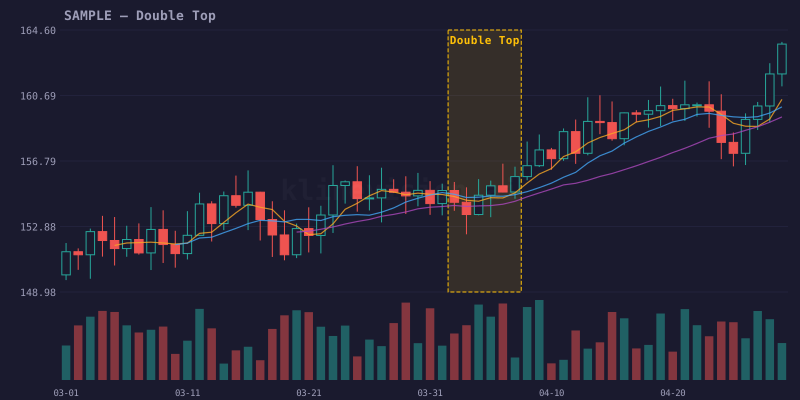
The Double Top is a classic bearish reversal chart pattern that typically forms after a sustained uptrend. It signals a potential shift from bullish to bearish momentum. Visually, it resembles the letter 'M' and consists of two distinct peaks at approximately the same price level, separated by a moderate trough. The formation begins with prices reaching a new high (the first peak) on strong volume, followed by a pullback to a support level, often referred to as the 'neckline.' Subsequently, prices rally again, attempting to surpass the previous high but failing, forming the second peak. Crucially, the volume on the second peak is often lower than on the first, indicating diminishing buying interest and a lack of conviction among bulls. The pattern is confirmed when the price breaks decisively below the neckline, which is the lowest point between the two peaks. This breakdown typically occurs on increased volume, signifying strong selling pressure. Thomas Bulkowski, in his 'Encyclopedia of Chart Patterns,' identifies the Double Top as a reliable reversal pattern, noting an average decline of approximately 19% after a confirmed breakdown. Its failure rate, where the price does not continue downwards after breaking the neckline, is around 13%. The pattern's effectiveness is enhanced when the peaks are well-defined and the breakdown is accompanied by significant volume.
Identification Rules
- Prior Uptrend: The pattern must be preceded by a clear and established uptrend, indicating that buyers were previously in control.
- Two Peaks: Identify two distinct price peaks that reach approximately the same price level. The second peak should ideally not significantly exceed the first.
- Intermediate Trough (Neckline): A clear pullback forming a trough must occur between the two peaks. This low point establishes the neckline.
- Breakdown Confirmation: The pattern is confirmed when the price decisively breaks and closes below the neckline established by the intermediate trough. This breakdown should ideally be accompanied by increased volume.
References
- Thomas N. Bulkowski (2005). Encyclopedia of Chart Patterns.
- Steve Nison (2001). Japanese Candlestick Charting Techniques.
FAQ
How do you calculate a price target for a Double Top pattern?
A common method for estimating a price target is to measure the vertical distance from the neckline to the highest peak of the pattern. This measured distance is then projected downwards from the point where the price breaks below the neckline. For example, if the distance from the neckline to the peak is $10, and the neckline breaks at $50, the target would be $40.
What is the typical reliability and performance of a Double Top?
According to Thomas Bulkowski's research, the Double Top is a relatively reliable bearish reversal pattern. He found an average decline of approximately 19% after a confirmed breakdown. The pattern's failure rate, where the price reverses back above the neckline after a breakdown, is around 13%. Its performance rank among bearish reversal patterns is quite good, often placing it in the top half for post-breakdown declines.
What role does volume play in confirming a Double Top?
Volume is a critical indicator for the Double Top. Ideally, the first peak should form on high or increasing volume, reflecting strong buying interest. The rally to the second peak should occur on noticeably lower volume, indicating a weakening of buying pressure and a lack of conviction. Finally, the decisive breakdown below the neckline should be accompanied by a significant surge in volume, confirming strong selling pressure and the pattern's validity.
What is the difference between a Double Top and a Triple Top?
The primary difference lies in the number of peaks. A Double Top features two distinct peaks at roughly the same price level, signaling a reversal. A Triple Top, as its name suggests, has three distinct peaks at approximately the same price level, separated by two troughs. Both are bearish reversal patterns, but a Triple Top is generally considered a stronger and more reliable reversal signal due to the repeated failure of buyers to push prices higher.
Are there any common variations or nuances to consider with Double Tops?
Yes, variations exist. The two peaks don't have to be at the exact same price; a slight tilt or difference of a few percentage points is acceptable, as long as the overall 'M' shape is clear. Sometimes, the second peak might be slightly lower than the first, indicating even weaker buying power. Also, the neckline doesn't have to be perfectly horizontal; it can be slightly sloped. The most crucial aspect remains the decisive breakdown below the established support level (neckline) on increased volume.
More Analysis
Parts of this page (FAQ, introductions) are AI-assisted. Core data and statistics are algorithmically computed. All pattern definitions are human-reviewed.
Disclaimer: This page is based on publicly available market data and algorithmically generated technical analysis. It does not constitute investment advice. Historical pattern statistics do not guarantee future performance. Invest at your own risk.
Data source: EODHD · © 2026 KlineVision AI