Chan Zhongshu Complete Guide
What is Chan Zhongshu?
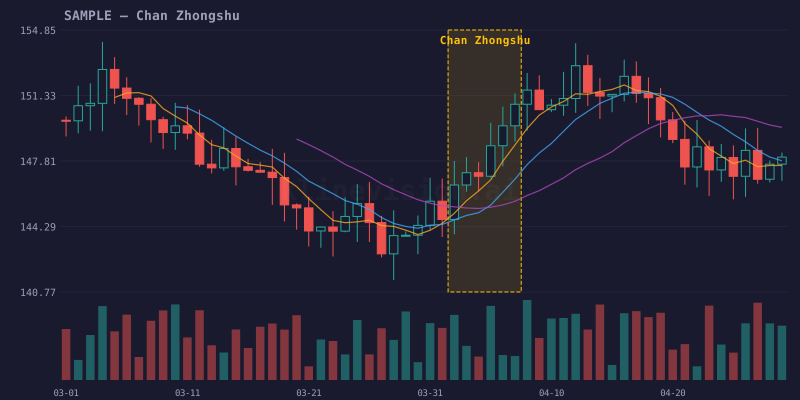
The 'Chan Zhongshu,' or Central Pivot, is the foundational concept of the 'Chan Theory' (Chanzhongshuochan), a sophisticated technical analysis framework originating from China. Unlike traditional Western patterns like triangles or flags, the Zhongshu is mathematically defined as the overlapping price range of at least three consecutive sub-level trend segments. Visually, it appears as a dense horizontal consolidation zone where price action oscillates within a defined range. It represents a state of temporary equilibrium between buyers and sellers, acting as a 'gravity center' for price action. In terms of formation, a Zhongshu requires a minimum of three segments (e.g., down-up-down or up-down-up) where the price ranges intersect. While Thomas Bulkowski does not explicitly categorize 'Chan Zhongshu' in his Encyclopedia of Chart Patterns, the structure closely mirrors 'Rectangles' or 'Congestion Areas.' According to Bulkowski’s data on rectangles, these patterns act as continuations roughly 60-70% of the time, with a breakout failure rate typically ranging from 9% to 16% depending on the market context. Volume characteristics during the formation of a Zhongshu typically show a noticeable contraction as the market reaches a consensus on value, followed by a significant surge upon a breakout. The pattern is considered 'neutral' until a breakout occurs, but within the Chan framework, it is primarily used to identify 'buy/sell points' (specifically the third type) which signal the continuation of the preceding trend. Its reliability is highly dependent on the 'fractal' nature of the market, meaning a Zhongshu on a daily chart carries more weight than one on a 5-minute chart. It is a powerful tool for identifying trend exhaustion or the start of a new impulsive move.
Identification Rules
- Must consist of at least three consecutive overlapping sub-level segments.
- The range is determined by the 'high of the lows' and 'low of the highs' of the first three segments.
- Requires a minimum of 20 bars to ensure structural maturity on the current timeframe.
- A valid breakout is confirmed only when a subsequent segment does not return to the Zhongshu range.
References
- Thomas N. Bulkowski (2005). Encyclopedia of Chart Patterns.
- Steve Nison (2001). Japanese Candlestick Charting Techniques.
FAQ
How does Zhongshu differ from a standard Rectangle?
While visually similar, Zhongshu is defined by overlapping segments rather than just price peaks, requiring stricter internal structure.
What is the historical success rate of this pattern?
As a continuation pattern similar to Bulkowski's rectangles, it has a 60-70% success rate in trending markets.
Does volume play a role in validating a Zhongshu?
Yes, volume contraction during formation and a 50% or higher surge on breakout validates the pivot's strength.
What is a 'Third-Type Buy Point' in this context?
It occurs when price pulls back after a breakout but stays above the Zhongshu high, signaling high-probability continuation.
Can a Zhongshu lead to a trend reversal?
Yes, if the exit move shows momentum divergence (MACD), it may signal trend exhaustion rather than continuation.
More Analysis
Parts of this page (FAQ, introductions) are AI-assisted. Core data and statistics are algorithmically computed. All pattern definitions are human-reviewed.
Disclaimer: This page is based on publicly available market data and algorithmically generated technical analysis. It does not constitute investment advice. Historical pattern statistics do not guarantee future performance. Invest at your own risk.
Data source: EODHD · © 2026 KlineVision AI