Channel Down Complete Guide
What is Channel Down?
The Channel Down, also known as a Descending Channel, is a bearish continuation pattern characterized by price action contained between two parallel, downward-sloping trendlines. It represents a period of controlled selling where each peak is lower than the previous one (lower highs) and each trough is lower than the previous one (lower lows). In a bearish continuation context, the pattern typically forms after a sharp decline, serving as a corrective phase or a consolidation where the bears maintain control but at a slower pace. According to Thomas Bulkowski’s research in the Encyclopedia of Chart Patterns, descending channels that break to the downside are effective continuation signals, though they can occasionally act as reversals if the upper trendline is breached. The formation requires at least two touches on the upper resistance line and two touches on the lower support line to establish parallelism. Volume typically trends downward as the channel develops, reflecting a decrease in conviction until the breakout occurs. A decisive close below the lower trendline confirms the pattern, signaling that the primary downtrend has resumed. Bulkowski notes that the average decline following a downward breakout in a bull market is approximately 15%, with a failure rate of roughly 11%. Traders often measure the price target by calculating the height of the channel and projecting it downward from the breakout point. It is crucial to distinguish this from a falling wedge; in a channel, the trendlines must remain roughly parallel rather than converging.
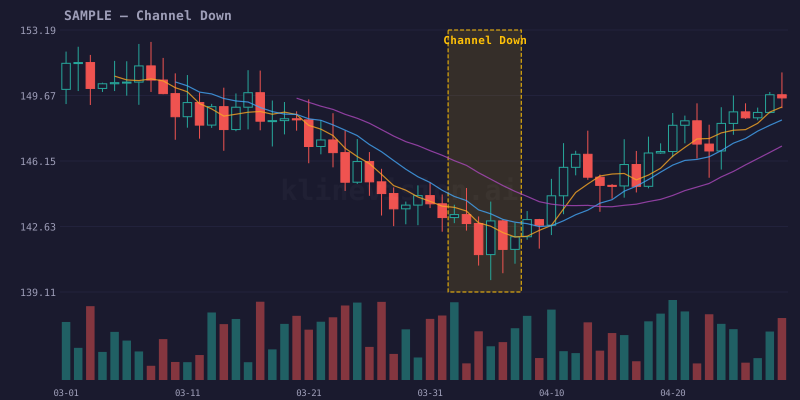
Identification Rules
- The pattern must consist of two parallel trendlines sloping downwards.
- Price must touch the upper resistance line at least twice and the lower support line at least twice.
- The price action must show a clear sequence of lower highs and lower lows within the channel.
- A minimum of 20 bars is generally required to establish a valid channel structure.
References
- Thomas N. Bulkowski (2005). Encyclopedia of Chart Patterns.
- Steve Nison (2001). Japanese Candlestick Charting Techniques.
FAQ
What is the primary difference between a Channel Down and a Falling Wedge?
In a Channel Down, the trendlines are parallel. In a Falling Wedge, the trendlines converge toward an apex. Parallel lines suggest a steady trend, while converging lines suggest waning momentum.
How do you calculate the price target for a downward breakout?
Measure the vertical height of the channel and subtract that value from the breakout price on the lower trendline. This provides a conservative minimum target.
What does volume typically do during the formation of this pattern?
Volume usually trends downward as the pattern forms. A spike in volume during the downward breakout provides additional confirmation of the pattern's validity.
What is the failure rate of a Channel Down breaking to the downside?
According to Bulkowski, the failure rate for a downward breakout in a bull market is approximately 11%, making it a relatively reliable continuation signal.
Can a Channel Down result in a bullish reversal?
Yes. If the price breaks and closes above the upper trendline, it is considered a bullish reversal. Bulkowski notes that upward breakouts from descending channels actually occur frequently and can be quite profitable.
More Analysis
Parts of this page (FAQ, introductions) are AI-assisted. Core data and statistics are algorithmically computed. All pattern definitions are human-reviewed.
Disclaimer: This page is based on publicly available market data and algorithmically generated technical analysis. It does not constitute investment advice. Historical pattern statistics do not guarantee future performance. Invest at your own risk.
Data source: EODHD · © 2026 KlineVision AI