Dragonfly Doji Complete Guide
What is Dragonfly Doji?
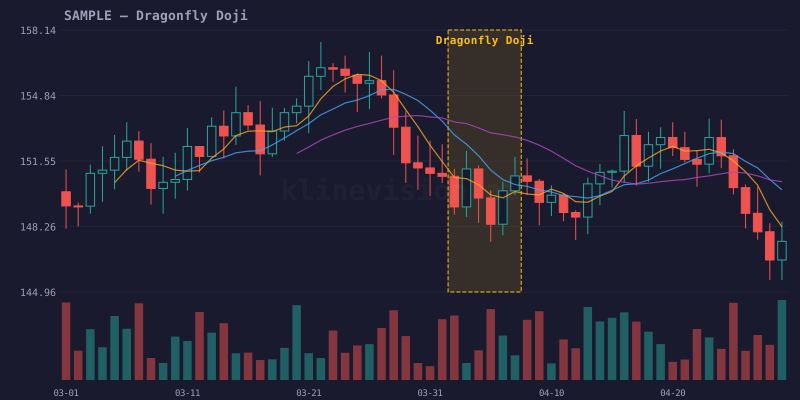
The Dragonfly Doji is a single-bar candlestick pattern that signals a potential reversal in price direction, most notably appearing at the bottom of downtrends. It is characterized by a session where the open, high, and close prices are identical or nearly identical, situated at the very top of the candle's range. This creates a 'T' shape with a long lower shadow and virtually no upper wick. From a psychological perspective, the formation represents a session where sellers aggressively pushed prices lower, but by the close, buyers regained complete control, driving the price back to the opening level. This rejection of lower prices suggests that the prevailing bearish momentum is exhausting and a bottom may be forming. According to Steve Nison, the father of modern candlestick charting, the longer the lower shadow, the more significant the bullish potential. However, Thomas Bulkowski’s quantitative analysis in the 'Encyclopedia of Candlestick Charts' suggests that while the Dragonfly Doji is often viewed as a reversal, its theoretical performance can be mixed. In a downward trend, Bulkowski's data shows it acts as a bullish reversal 50% of the time, which statistically is a coin flip without further confirmation. However, its performance rank is high because when it does reverse, the ensuing move is often substantial. Volume typically spikes during the formation of a valid Dragonfly Doji, indicating a high-conviction 'washout' of sellers. Traders generally look for a bullish candle or a higher close on the following day to confirm the reversal before entering a long position. Its reliability increases significantly when it occurs at established support levels or in oversold conditions.
Identification Rules
- The Open, High, and Close prices are identical or very close to each other.
- The lower shadow is very long, representing the majority of the candle's height.
- There is little to no upper shadow present.
- The pattern must appear after a distinct downward price move to be considered a bullish reversal signal.
References
- Thomas N. Bulkowski (2005). Encyclopedia of Chart Patterns.
- Steve Nison (2001). Japanese Candlestick Charting Techniques.
FAQ
Is the Dragonfly Doji always a bullish signal?
No. While primarily a bullish reversal at the bottom of a trend, if it appears at the top of an uptrend, it can signal a bearish reversal (similar to a Hanging Man), though this is less common.
What does Bulkowski say about its reliability?
Bulkowski's research indicates a near 50% reversal rate in a downtrend, meaning it requires a confirmation candle on the following day to be traded safely.
How does volume impact the validity of this pattern?
Above-average volume on the day of the Dragonfly Doji suggests a stronger rejection of lower prices and increases the likelihood of a trend change.
What is the ideal length for the lower shadow?
Technically, the longer the better. Most analysts look for a shadow that is at least two to three times the size of the 'body' (if any).
Where should a stop-loss be placed when trading this pattern?
A standard stop-loss is placed just below the low of the Dragonfly Doji's long lower shadow.
More Analysis
Parts of this page (FAQ, introductions) are AI-assisted. Core data and statistics are algorithmically computed. All pattern definitions are human-reviewed.
Disclaimer: This page is based on publicly available market data and algorithmically generated technical analysis. It does not constitute investment advice. Historical pattern statistics do not guarantee future performance. Invest at your own risk.
Data source: EODHD · © 2026 KlineVision AI