Hanging Man Complete Guide
What is Hanging Man?
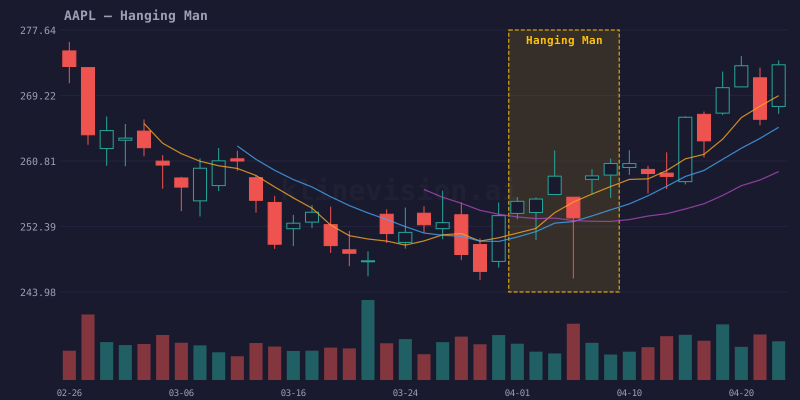
The Hanging Man is a single-bar bearish reversal candlestick pattern that appears at the peak of an uptrend. Visually, it is identical to the Hammer pattern, but its significance is determined entirely by the preceding price action. It features a small real body at the upper end of the trading range and a long lower shadow that is at least twice the height of the body. While the color of the body can be either green (bullish) or red (bearish), a red body typically signals a stronger potential reversal. The formation occurs when an asset opens near its high, experiences a significant sell-off during the session, but manages to recover to close near the opening price. According to Steve Nison, the father of modern candlestick charting, this price action suggests that despite the recovery, the bulls' control is fracturing, and the long lower shadow proves that bears are capable of driving prices down. Thomas Bulkowski’s research in the 'Encyclopedia of Candlestick Charts' indicates that the Hanging Man has a theoretical reversal rate of approximately 59%, though its actual performance can be closer to a coin flip without confirmation. Volume plays a critical role; a Hanging Man accompanied by high volume or followed by a gap down on the next day significantly increases the probability of a trend reversal. Bulkowski notes that the pattern performs best in a bear market with a downward breakout. However, traders are strictly advised to wait for a bearish confirmation—specifically, a close below the Hanging Man's body on the following candle—before entering a short position, as the pattern frequently fails or acts as a temporary consolidation in strong bull markets.
Identification Rules
- The small real body is located at the upper end of the trading range.
- The lower shadow must be at least two to three times the length of the real body.
- There should be little to no upper shadow on the candle.
- The pattern must appear after a clear uptrend or at a significant resistance level.
Historical Win Rate Statistics
US
| Total Occurrences | 11 |
| T+5 Win Rate | 27.3% |
| T+20 Win Rate | 50.0% |
| T+20 Avg Return | -0.29% |
Recent Cases
| Symbol | Date | T+20 Return |
|---|---|---|
| AMZN | 2025-06-10 | 0.82% |
| ACHFF | 2025-06-09 | -0.73% |
| AAGC | 2025-06-06 | 0.00% |
| AAGC | 2025-06-05 | 0.00% |
| AAUC | 2025-06-05 | -13.68% |
| ABXXF | 2025-06-05 | 9.53% |
| AACIU | 2025-06-05 | 0.88% |
| ACIXF | 2025-06-04 | -29.28% |
| ABMRF | 2025-05-14 | 10.90% |
| AASP | 2025-05-13 | -23.33% |
References
- Thomas N. Bulkowski (2005). Encyclopedia of Chart Patterns.
- Steve Nison (2001). Japanese Candlestick Charting Techniques.
FAQ
Does the color of the Hanging Man's body matter?
While both colors are valid, a red (bearish) body is considered more reliable as it indicates the close was lower than the open, showing more selling pressure.
Is confirmation required for this pattern?
Yes. Technical analysts like Nison and Bulkowski emphasize waiting for the next candle to close below the Hanging Man's body to confirm the reversal.
What is the historical success rate of the Hanging Man?
According to Bulkowski's data, it acts as a bearish reversal 59% of the time in a bull market, which is only slightly better than random chance.
How does a Hanging Man differ from a Hammer?
They are visually identical. The difference is context: a Hammer occurs after a price decline, while a Hanging Man occurs after a price advance.
What does the long lower shadow represent?
It represents a period during the session where sellers took control and pushed prices down significantly, signaling that the trend may be losing momentum.
More Analysis
Parts of this page (FAQ, introductions) are AI-assisted. Core data and statistics are algorithmically computed. All pattern definitions are human-reviewed.
Disclaimer: This page is based on publicly available market data and algorithmically generated technical analysis. It does not constitute investment advice. Historical pattern statistics do not guarantee future performance. Invest at your own risk.
Data source: EODHD · © 2026 KlineVision AI