強気相場開始 Complete Guide
What is 強気相場開始?
The Bullish Kicking pattern is a powerful two-candle technical formation that signals a violent and immediate shift in market sentiment. Visually, it consists of two Marubozu candles of opposite colors separated by a price gap. The first bar is a Black (or Red) Marubozu, characterized by a long real body with little to no shadows, indicating strong selling pressure. The second bar is a White (or Green) Marubozu that gaps significantly higher, opening at or above the opening price of the previous day and moving further upward. This 'kick' represents a complete rejection of the previous bearishness, often triggered by surprise news or a fundamental shift in valuation. According to Steve Nison, the father of modern candlestick charting, the Kicking pattern is one of the most potent signals because it shows the market's direction has been forcefully shoved in a new direction. Thomas Bulkowski, in his 'Encyclopedia of Candlestick Charts,' ranks the Bullish Kicking as one of the best-performing patterns. His data suggests that while the pattern is rare, it acts as a bullish reversal 53% of the time in a bear market and a bullish continuation 71% of the time in a bull market. Volume typically surges on the second day, confirming the conviction of the buyers. Because the pattern is so aggressive, it often leads to a sustained rally, though its rarity means traders must be vigilant to identify it correctly without confusing it with less powerful gap patterns.
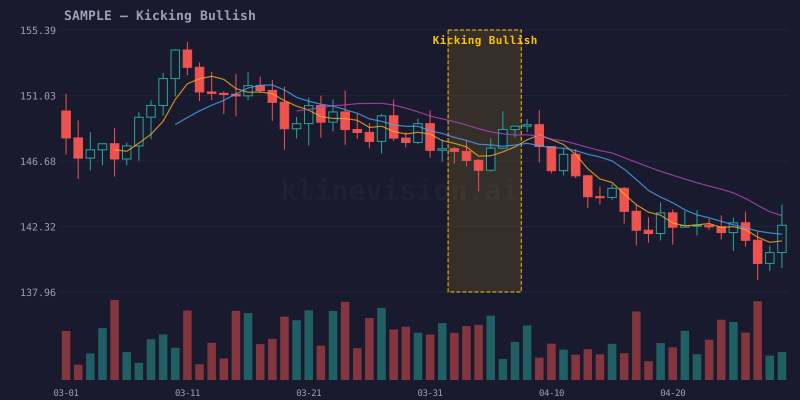
Identification Rules
- 最初のローソク足は、長い実体と最小限のヒゲを持つ黒(弱気)の丸坊主でなければなりません。
- 二本目のローソク足は、長い実体とわずかなヒゲを持つ白(強気)の丸坊主でなければなりません。
- ギャップアップは、1本目と2本目のローソク足の間に発生する必要があります。
- The second candle's opening price must be at or above the opening price of the first candle.
References
- Thomas N. Bulkowski (2005). Encyclopedia of Chart Patterns.
- Steve Nison (2001). Japanese Candlestick Charting Techniques.
FAQ
強気キッカーパターンの信頼性はどの程度ですか?
It is considered one of the most reliable patterns. Bulkowski's research indicates it has a high overall performance rank, often leading to significant price moves due to the extreme shift in momentum.
What is the difference between Kicking and Separating Lines?
強気セパレーティングラインでは、1本目のローソク足は弱気ですが、トレンドはすでに強気です。強気キッカーでは、1本目のローソク足が弱気心理を強めますが、2本目のローソク足によってそれが激しく反転します。
Does volume matter for this pattern?
はい、2本目の(強気)ローソク足における高い出来高は、機関投資家が「キック」を牽引していることを裏付けるため、パターンの信頼性を大幅に高めます。
ストップロスはどこに置くべきでしょうか?
ストップロスの一般的なテクニカルな設定箇所は、パターンにおける最初の(弱気)ローソク足の安値の下です。
このパターンは日足チャートでよく見られるものですか?
ブル・キッカーは、特定のギャップと2本の丸坊主を必要とするため比較的まれであり、出現時には信頼性の高いシグナルとなります。
More Analysis
Parts of this page (FAQ, introductions) are AI-assisted. Core data and statistics are algorithmically computed. All pattern definitions are human-reviewed.
免責事項:本ページは公開市場データとアルゴリズムによるテクニカル分析に基づいています。投資助言を構成するものではありません。
Data source: EODHD · © 2026 KlineVision AI