Triple Top Complete Guide
What is Triple Top?
The Triple Top is a classic bearish reversal pattern characterized by three distinct peaks reaching nearly the same price level, separated by two intervening troughs. This pattern signals that an existing uptrend is losing momentum as the asset fails to break through a significant resistance zone on three separate attempts. It is essentially an extension of the Double Top, indicating even stronger resistance. Technically, the formation begins with a peak followed by a retracement to a support level (the neckline). A second rally fails at the same resistance, followed by another dip. The final attempt also fails, often on lower volume, suggesting buyer exhaustion. The pattern is only confirmed when the price closes below the lowest point of the two troughs. Volume characteristics are crucial: volume typically diminishes on each successive peak, showing waning enthusiasm. However, a sharp increase in volume during the breakout below the neckline is a strong validation signal. According to Thomas Bulkowski’s research in the Encyclopedia of Chart Patterns, Triple Tops are less common than Double Tops but are highly reliable. Bulkowski notes a failure rate of approximately 11% in bull markets, with an average decline of 19% following a valid downward breakout. Steve Nison, in his work on Japanese Candlesticks, refers to a similar structure as the 'Three Buddha Top,' emphasizing the psychological significance of the market's inability to sustain new highs. Traders often project a price target by measuring the height from the peaks to the neckline and subtracting that distance from the breakout point.
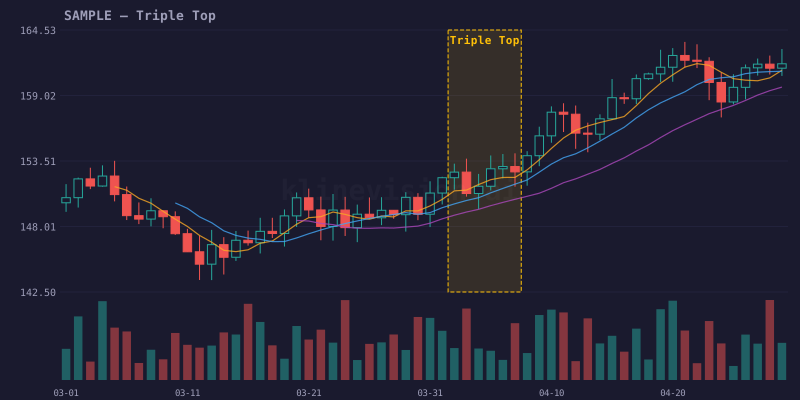
Identification Rules
- The pattern must be preceded by an established uptrend to be considered a reversal.
- Three distinct peaks should reach approximately the same price level, usually within a 2% to 3% range.
- The 'neckline' is established by drawing a horizontal line through the lowest points of the two intervening troughs.
- Confirmation requires a decisive close below the neckline, ideally accompanied by an expansion in trading volume.
References
- Thomas N. Bulkowski (2005). Encyclopedia of Chart Patterns.
- Steve Nison (2001). Japanese Candlestick Charting Techniques.
FAQ
How does a Triple Top differ from a Head and Shoulders pattern?
In a Triple Top, all three peaks are at roughly the same level. In a Head and Shoulders, the middle peak (the head) is significantly higher than the two outside peaks (the shoulders).
What is the historical failure rate of this pattern?
According to Bulkowski's data, the Triple Top has a failure rate of about 11% in bull markets, meaning the price fails to drop at least 5% after the breakout.
Is volume required for a valid breakout?
While not strictly required for the pattern to exist, a high-volume breakout significantly increases the probability of a successful trade and a sustained decline.
How do I calculate the profit target?
Measure the vertical distance from the highest peak to the neckline. Subtract this value from the breakout price level to find the minimum price target.
What happens if the price breaks above the peaks?
If the price closes above the resistance level formed by the three peaks, the bearish pattern is invalidated, and the previous uptrend is likely resuming.
More Analysis
Parts of this page (FAQ, introductions) are AI-assisted. Core data and statistics are algorithmically computed. All pattern definitions are human-reviewed.
Disclaimer: This page is based on publicly available market data and algorithmically generated technical analysis. It does not constitute investment advice. Historical pattern statistics do not guarantee future performance. Invest at your own risk.
Data source: EODHD · © 2026 KlineVision AI