V Bottom Complete Guide
What is V Bottom?
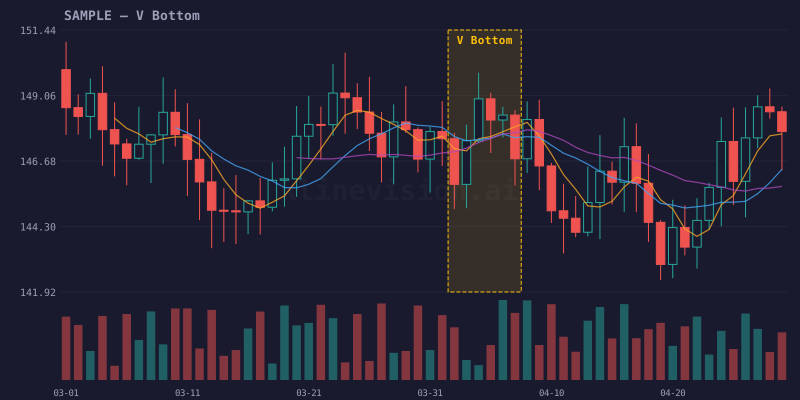
The V-Bottom, also known as a 'Spike' or 'V-Reversal,' is a powerful bullish reversal pattern characterized by a sharp, aggressive decline followed by an equally rapid recovery. Unlike more gradual patterns like the Double Bottom or Cup and Handle, the V-Bottom lacks a period of consolidation or 'basing' at the low. It typically forms during periods of extreme market volatility or in response to sudden, high-impact news events that trigger panic selling. According to Thomas Bulkowski’s research in the 'Encyclopedia of Chart Patterns,' the V-bottom is one of the most difficult patterns to identify in real-time because the 'turn' happens so quickly. The pattern begins with a steep downtrend, often accelerating into a selling climax. At the lowest point, the price hits a 'spike' low on exceptionally high volume, signaling that the last of the sellers have been exhausted. This is immediately followed by a sharp price surge, often on high volume, as buyers aggressively step in. Bulkowski’s data suggests that while V-bottoms are common, they have a failure rate of approximately 18% in bull markets when looking for a 10% price rise. The average rise following a confirmed breakout is roughly 38%. For a V-bottom to be technically valid, the recovery should retrace a significant portion of the prior decline, ideally breaking above the previous 'peak' that started the final plunge. Traders often look for a 'one-day reversal' candlestick or a 'tower bottom' (as described by Steve Nison) at the pivot point to confirm the shift in momentum. Because of the lack of a base, risk management is critical, as the rapid ascent can just as easily fail if buying pressure dissipates.
Identification Rules
- Prior Trend: A steep, nearly vertical downtrend must precede the bottoming spike.
- Pivot Point: A sharp, single-day or single-bar 'V' shaped turning point with no horizontal consolidation.
- Volume Climax: A significant surge in volume at the absolute low, indicating a selling climax or capitulation.
- Symmetrical Recovery: The subsequent price advance should be as sharp and aggressive as the prior decline.
References
- Thomas N. Bulkowski (2005). Encyclopedia of Chart Patterns.
- Steve Nison (2001). Japanese Candlestick Charting Techniques.
FAQ
How does a V-Bottom differ from a Double Bottom?
A V-Bottom has only one sharp pivot point and no retest of the low, whereas a Double Bottom features two distinct lows separated by a peak.
What is the statistical failure rate of this pattern?
According to Bulkowski, the failure rate is approximately 18% for a 10% rise in bull markets, making it relatively reliable if confirmed.
Is volume necessary for a valid V-Bottom?
Yes, high volume at the bottom confirms exhaustion, and high volume on the way up confirms strong buying interest.
Where should a stop-loss be placed?
Typically, a stop-loss is placed just below the lowest point of the 'V' spike to protect against a continuation of the downtrend.
What triggers a V-Bottom formation?
It is usually triggered by an 'overreaction' to news, followed by a sudden realization of value or a counter-news event that reverses sentiment.
More Analysis
Parts of this page (FAQ, introductions) are AI-assisted. Core data and statistics are algorithmically computed. All pattern definitions are human-reviewed.
Disclaimer: This page is based on publicly available market data and algorithmically generated technical analysis. It does not constitute investment advice. Historical pattern statistics do not guarantee future performance. Invest at your own risk.
Data source: EODHD · © 2026 KlineVision AI